|
Gallus BioPharmaceuticals
ncbi reference sequence: np_990625 Ncbi Reference Sequence: Np 990625, supplied by Gallus BioPharmaceuticals, used in various techniques. Bioz Stars score: 90/100, based on 1 PubMed citations. ZERO BIAS - scores, article reviews, protocol conditions and more https://www.bioz.com/product/ncbi+reference+sequence/ncbi+reference+sequence++np+990625/pmc04333900-583-93-94 Average 90 stars, based on 1 article reviews
ncbi reference sequence: np_990625 - by Bioz Stars,
2026-10
90/100 stars
|
Buy from Supplier |
|
Gallus BioPharmaceuticals
ncbi reference sequences of tm4sf1, tm4sf4, tm4sf18 proteins of each species Ncbi Reference Sequences Of Tm4sf1, Tm4sf4, Tm4sf18 Proteins Of Each Species, supplied by Gallus BioPharmaceuticals, used in various techniques. Bioz Stars score: 90/100, based on 1 PubMed citations. ZERO BIAS - scores, article reviews, protocol conditions and more https://www.bioz.com/product/ncbi+reference+sequence/ncbi+reference+sequences+of+tm4sf1++tm4sf4++tm4sf18+proteins+of+each+species/pmc06581738-345-14-45 Average 90 stars, based on 1 article reviews
ncbi reference sequences of tm4sf1, tm4sf4, tm4sf18 proteins of each species - by Bioz Stars,
2026-10
90/100 stars
|
Buy from Supplier |
|
GenScript corporation
plasmid: hkcnk5-flag.dn3 Plasmid: Hkcnk5 Flag.Dn3, supplied by GenScript corporation, used in various techniques. Bioz Stars score: 90/100, based on 1 PubMed citations. ZERO BIAS - scores, article reviews, protocol conditions and more https://www.bioz.com/product/ncbi+reference+sequence/hkcnk5++flag+dn3+++979++plasmid+encoding+the+human+kcnk5+potassium+channel++ncbi+reference+sequence+nm+003740+3+++flag++tagged+at+the+c++terminus/pmc08639150-60-5-7 Average 90 stars, based on 1 article reviews
plasmid: hkcnk5-flag.dn3 - by Bioz Stars,
2026-10
90/100 stars
|
Buy from Supplier |
|
Gallus BioPharmaceuticals
h4 ncbi reference sequence: np_001032932.1  H4 Ncbi Reference Sequence: Np 001032932.1, supplied by Gallus BioPharmaceuticals, used in various techniques. Bioz Stars score: 90/100, based on 1 PubMed citations. ZERO BIAS - scores, article reviews, protocol conditions and more https://www.bioz.com/product/ncbi+reference+sequence/h4+ncbi+reference+sequence++np+001032932+1/pmc05600342-87-21-0 Average 90 stars, based on 1 article reviews
h4 ncbi reference sequence: np_001032932.1 - by Bioz Stars,
2026-10
90/100 stars
|
Buy from Supplier |
|
GenScript corporation
sudv gp gene (ncbi reference sequence nc_006432.1) Sudv Gp Gene (Ncbi Reference Sequence Nc 006432.1), supplied by GenScript corporation, used in various techniques. Bioz Stars score: 90/100, based on 1 PubMed citations. ZERO BIAS - scores, article reviews, protocol conditions and more https://www.bioz.com/product/ncbi+reference+sequence/sudv+gp+gene++ncbi+reference+sequence+nc+006432+1+/pm39715280-268-25-34 Average 90 stars, based on 1 article reviews
sudv gp gene (ncbi reference sequence nc_006432.1) - by Bioz Stars,
2026-10
90/100 stars
|
Buy from Supplier |
|
GenScript corporation
rfx6 coding region (wt: ncbi reference sequence: nm_173560.4)  Rfx6 Coding Region (Wt: Ncbi Reference Sequence: Nm 173560.4), supplied by GenScript corporation, used in various techniques. Bioz Stars score: 90/100, based on 1 PubMed citations. ZERO BIAS - scores, article reviews, protocol conditions and more https://www.bioz.com/product/ncbi+reference+sequence/rfx6+coding+region++wt++ncbi+reference+sequence++nm+173560+4+/bio_rxiv__2023__11__09__566480-258-0-46 Average 90 stars, based on 1 article reviews
rfx6 coding region (wt: ncbi reference sequence: nm_173560.4) - by Bioz Stars,
2026-10
90/100 stars
|
Buy from Supplier |
|
GenScript corporation
full-length human calhm5 (ncbi reference sequence: np_714922.1) Full Length Human Calhm5 (Ncbi Reference Sequence: Np 714922.1), supplied by GenScript corporation, used in various techniques. Bioz Stars score: 90/100, based on 1 PubMed citations. ZERO BIAS - scores, article reviews, protocol conditions and more https://www.bioz.com/product/ncbi+reference+sequence/full+length+human+calhm5++ncbi+reference+sequence++np+714922+1+/pmc07652935__41421_2020_228_MOESM1_ESM-0-3-19 Average 90 stars, based on 1 article reviews
full-length human calhm5 (ncbi reference sequence: np_714922.1) - by Bioz Stars,
2026-10
90/100 stars
|
Buy from Supplier |
|
GenScript corporation
jatropha curcas casbene synthase (jccbs)  Jatropha Curcas Casbene Synthase (Jccbs), supplied by GenScript corporation, used in various techniques. Bioz Stars score: 90/100, based on 1 PubMed citations. ZERO BIAS - scores, article reviews, protocol conditions and more https://www.bioz.com/product/ncbi+reference+sequence/jatropha+curcas+casbene+synthase++jccbs++ncbi+reference+sequence++np+001292945+1+/pmc07309327-159-6-28 Average 90 stars, based on 1 article reviews
jatropha curcas casbene synthase (jccbs) - by Bioz Stars,
2026-10
90/100 stars
|
Buy from Supplier |
|
Gallus BioPharmaceuticals
ncbi reference sequence for the protein sequence of spc24 homologues: gallus gallus (xp_015129502.1) Ncbi Reference Sequence For The Protein Sequence Of Spc24 Homologues: Gallus Gallus (Xp 015129502.1), supplied by Gallus BioPharmaceuticals, used in various techniques. Bioz Stars score: 90/100, based on 1 PubMed citations. ZERO BIAS - scores, article reviews, protocol conditions and more https://www.bioz.com/product/ncbi+reference+sequence/ncbi+reference+sequence+for+the+protein+sequence+of+spc24+homologues++gallus+gallus++xp+015129502+1+/pm29356153-273-96-98 Average 90 stars, based on 1 article reviews
ncbi reference sequence for the protein sequence of spc24 homologues: gallus gallus (xp_015129502.1) - by Bioz Stars,
2026-10
90/100 stars
|
Buy from Supplier |
|
Gallus BioPharmaceuticals
h2a ncbi reference sequence: aac60008.1 H2a Ncbi Reference Sequence: Aac60008.1, supplied by Gallus BioPharmaceuticals, used in various techniques. Bioz Stars score: 90/100, based on 1 PubMed citations. ZERO BIAS - scores, article reviews, protocol conditions and more https://www.bioz.com/product/ncbi+reference+sequence/h2a+ncbi+reference+sequence++aac60008+1/pmc05600342-87-6-0 Average 90 stars, based on 1 article reviews
h2a ncbi reference sequence: aac60008.1 - by Bioz Stars,
2026-10
90/100 stars
|
Buy from Supplier |
|
GenScript corporation
hdac4wt (nucleotides 461 – 4216 ncbi reference sequence nm_132640 Hdac4wt (Nucleotides 461 – 4216 Ncbi Reference Sequence Nm 132640, supplied by GenScript corporation, used in various techniques. Bioz Stars score: 90/100, based on 1 PubMed citations. ZERO BIAS - scores, article reviews, protocol conditions and more https://www.bioz.com/product/ncbi+reference+sequence/hdac4wt++nucleotides+461+++4216+ncbi+reference+sequence+nm+132640/pm38167120-346-5-23 Average 90 stars, based on 1 article reviews
hdac4wt (nucleotides 461 – 4216 ncbi reference sequence nm_132640 - by Bioz Stars,
2026-10
90/100 stars
|
Buy from Supplier |
|
GenScript corporation
a codon-optimized plasmid containing the coding sequence of mouse prepronpy (ncbi reference sequence: nm_023456.3) A Codon Optimized Plasmid Containing The Coding Sequence Of Mouse Prepronpy (Ncbi Reference Sequence: Nm 023456.3), supplied by GenScript corporation, used in various techniques. Bioz Stars score: 90/100, based on 1 PubMed citations. ZERO BIAS - scores, article reviews, protocol conditions and more https://www.bioz.com/product/ncbi+reference+sequence/a+codon+optimized+plasmid+containing+the+coding+sequence+of+mouse+prepronpy++ncbi+reference+sequence++nm+023456+3+/pmc08187774-70-8-17 Average 90 stars, based on 1 article reviews
a codon-optimized plasmid containing the coding sequence of mouse prepronpy (ncbi reference sequence: nm_023456.3) - by Bioz Stars,
2026-10
90/100 stars
|
Buy from Supplier |
Image Search Results
Journal: Biochemistry and Biophysics Reports
Article Title: Expression and purification of the full murine NPM2 and study of its interaction with protamines and histones
doi: 10.1016/j.bbrep.2016.04.002
Figure Lengend Snippet: Native PAGE of a titration of histone octamers (A) and mouse protamines P1/P2 (B) with increasing amounts of M.NPM2. ). In this type of analysis, NPM2: histone/protamine complexes display a complex ‘shift’ and are unable to enter the gel. (C) Amino acid sequence of mouse NPM2 and core histones H2A, H2B and H4, with interaction sites determined through CXMS data ( a) highlighted in red. Three peptide sequences in NPM2 represent strong cross-linking candidates with sequences in H2A, H2B and H4 (highlighted in red). Gallus gallus H2A NCBI Reference Sequence: AAC60008.1, G. gallus H2B NCBI Reference Sequence: AAC60000.1 , G. gallus H4 NCBI Reference Sequence: NP_001032932.1. (D) Amino acid sequence of mouse NPM2, P1 and P2, with possible interaction sites determined through CXMS data ( a) highlighted in red. Three peptide sequences within M.NPM2 represent possible cross-linking candidates. M. musculus NPM2 NCBI Reference Sequence: NP_851990.2; M. musculus P1 NCBI Reference Sequence: NP_038665.1; M. musculus P2 NCBI Reference Sequence: P07978.1.
Article Snippet:
Techniques: Clear Native PAGE, Titration, Sequencing
Journal: bioRxiv
Article Title: Human organoid modeling of congenital malformations caused by RFX6 mutations reveal an essential role for this transcription factor in establishing and maintaining duodenal identity upstream of PDX1
doi: 10.1101/2023.11.09.566480
Figure Lengend Snippet: A) Patient mutation diagram in paternal and maternal alleles compared to WT allele, endoscopy image of polyps in Duodenum. B) Staining of Rfx6 Mut Patient biopsy compared to healthy duodenal biopsy showing gastric metaplasia (CLDN18), PDX1, SATB2 and MUC2 changes and loss of EECs (CHGA). C) Expression of Rfx6 in Duodenal and Ileal HIOs in vitro and in vivo (RFX6=Green) (scale bar =100um). D) Rfx6 mRNA expression in WT vs Rfx6 Mut HIOs (n=3). E) Staining of Duod and Ileum HIOs from Rfx6 Mut iPSC vs WT Duod and Ileum iPSC HIO shows duodenum phenotypes while ileum is normal excluding loss of EECs. F) Quantification of the staining of the HIOs for the patterning and secretory markers (n=3-8). (markers from panel C) (scale bar=100um). F) Quantification of HIO staining of the Duodenum WT vs RFX6 Mut HIOs (n=3-6). Significance determined by unpaired t-test with *p<0.05, **p<0.01, ***p<0.001.
Article Snippet:
Techniques: Mutagenesis, Staining, Expressing, In Vitro, In Vivo
Journal: bioRxiv
Article Title: Human organoid modeling of congenital malformations caused by RFX6 mutations reveal an essential role for this transcription factor in establishing and maintaining duodenal identity upstream of PDX1
doi: 10.1101/2023.11.09.566480
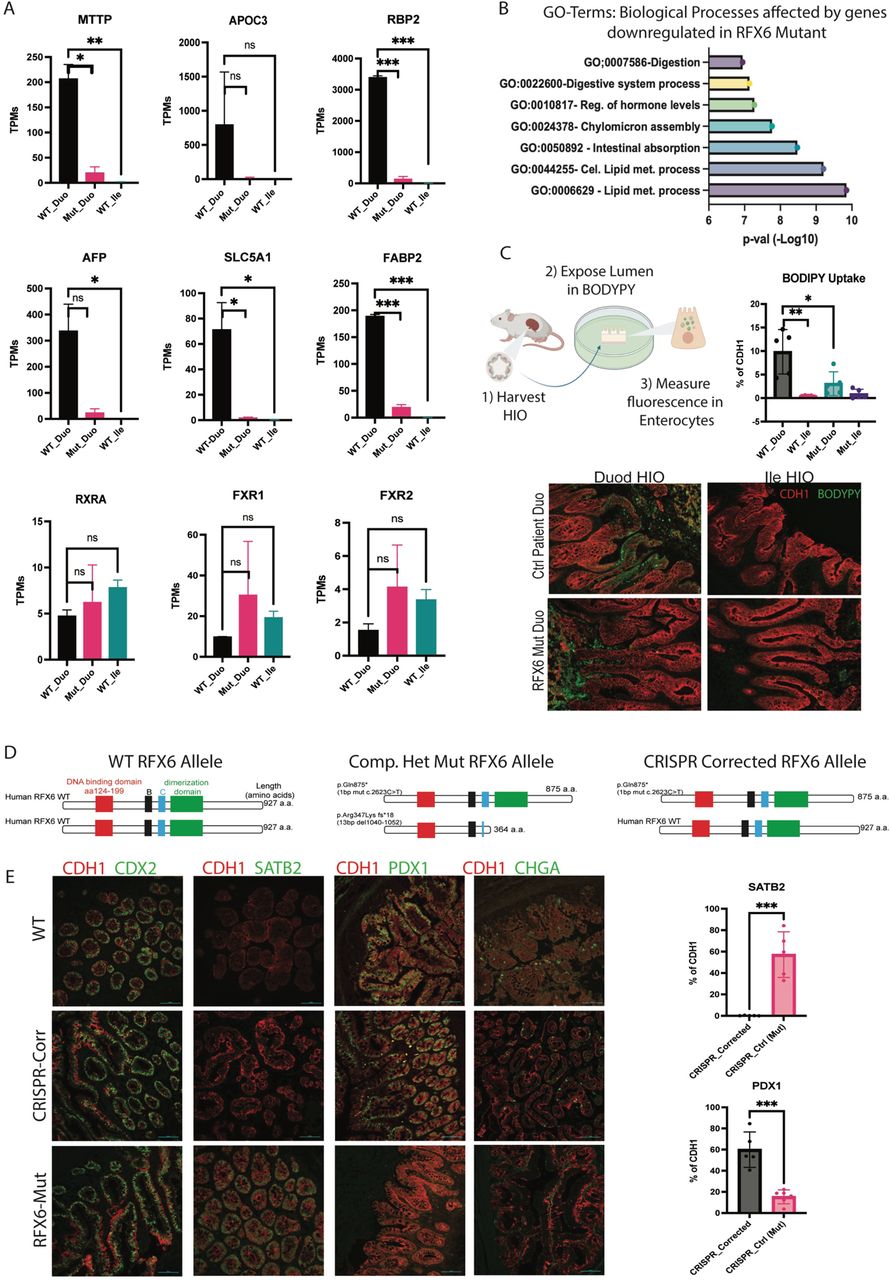
Figure Lengend Snippet: A) Genes involved in Duod functions are downregulated in Mut HIOs while genes involved in Ileal functions do not change. Results were obtained from independent transplanted organoids (n=2). B) Gene Ontology results for Biological Processes by genes significantly Downregulated in Rfx6 Mutant HIOs as compared to WT. C) Fluorescently labeled lipid (Bodipy) uptake in WT HIO vs Mut HIOs (n=3). D) Schematic of WT RFX6 allele vs Compound Heterozygous Mutant RFX6 allele vs CRISPR corrected RFX6 Allele. E) Staining of Corrected vs Mutant HIOs compared to WT HIOs showing patterning markers return to normal and Enteroendocrine population is recovered (n=3-7) (scale bar=100um). Significance determined by unpaired t-test with *p<0.05, **p<0.01, ***p<0.001. Significant Differentially expressed genes from Bulk RNA sequencing was defined by adjusted p-value of <.05.
Article Snippet:
Techniques: Mutagenesis, Labeling, CRISPR, Staining, RNA Sequencing

Journal: bioRxiv
Article Title: Human organoid modeling of congenital malformations caused by RFX6 mutations reveal an essential role for this transcription factor in establishing and maintaining duodenal identity upstream of PDX1
doi: 10.1101/2023.11.09.566480
Figure Lengend Snippet: A) Schematic of Organoid generation and harvesting timepoint for bulk RNA sequencing. B) Changes in components of relevant signaling pathways that are affected in Rfx6 Mut D7 HIOs (Wnt, BMP and HH pathways) and other members of the RFX family based on RNA Counts (n=3). C) Transcription factors involved in mid/hindgut patterning are also affected in Rfx6 Mut D7 HIOs based on RNA Counts (n=3). D) Organ markers from atlas showing intestinal markers are down in Rfx6-Mut HIOs based on RNA Counts (n=3) (Yu et al. 2022) E) PCA of WT vs RFx6 Mut and CRISPR Corrected D7 HIOs with percentage of genes upregulated by CRISPR Correction, 18.1%. F) Upregulated components of several signaling pathways increase in CRISPR Corrected D7 HIOs based on RNA Counts (n=3). G) Patterning markers return to levels closer to control in CRISPR Corrected D7 HIOs based on RNA Counts (n=3). Significance determined by unpaired t-test with *p<0.05, **p<0.01, ***p<0.001. Significant Differentially expressed genes from Bulk RNA sequencing was defined by adjusted p-value of <.05.
Article Snippet:
Techniques: RNA Sequencing, Protein-Protein interactions, CRISPR, Control

Journal: bioRxiv
Article Title: Human organoid modeling of congenital malformations caused by RFX6 mutations reveal an essential role for this transcription factor in establishing and maintaining duodenal identity upstream of PDX1
doi: 10.1101/2023.11.09.566480
Figure Lengend Snippet: A) RT-PCR expression of PDX1 and SATB2 when correcting one allele of RFX6 in 35d HIOs (n=3). B) In situ hybridization of pdx1 (expression domain abbreviations: st, stomach; duo, duodenum; vp, ventral pancreas; dp, dorsal pancreas; gb, gall bladder) and satb2 (abbreviation: hg, hindgut) in stage NF33 (2.5 d.p.f) Xenopus embryos. Numbers in the lower left corner of panel indicate number of embryos assayed with the shown gene expression pattern. C-E) Experimental schematic and human RFX6 transcription factor (TF) activity assay in Xenopus. Dexamethasone (DEX) inducible expression constructs were generated for human RFX6 WT, p.Gln875*stop, and p.Arg347Lys.fs18*stop as described in the text. mRNA encoding each was in vitro transcribed and then injected and pools of n=4 explants were pooled in triplicate for RT-qPCR analysis of gene expression, normalized to the housekeeping gene odc and relative to uninjected, untreated HG endo explants (D-E). D) RT-qPCR analysis of HG endo explants after 8hours of TF (DEX) induction shows that human WT RFX6 and human p.Gln875*stop. E) pdx1 is a direct target of RFX6. Red bar= expression of endogenous pdx1 in foregut endoderm explants (relative to uninjected, untreated HG endo) as a comparison. F ) Visualization of an evolutionarily conserved upstream PDX1 enhancer. UCSC genome browser shot of the human PDX1 locus is shown below with tracks from the indicated species, with black bars indicating regions of evolutionary conservation. ( G ) Experimental schematic of the Xenopus luciferase reporter assay used to test RFX6 dependent regulation of the human PDX1 enhancer. ( H-I) RFX6 regulates human PDX1 enhancer activity and mutation of 6 CisBP predicted (Weirach et al 2014) RFX motifs abolishes RFX6 responsiveness. Each black dot in the luciferase activity graphs represents pool of n=5 embryos, mean relative luciferase activity +/- standard deviation is graphed. Asterisks*= p<0.05, parametric two-tailed paired t-test.
Article Snippet:
Techniques: Reverse Transcription Polymerase Chain Reaction, Expressing, In Situ Hybridization, Gene Expression, Activity Assay, Construct, Generated, In Vitro, Injection, Quantitative RT-PCR, Comparison, Luciferase, Reporter Assay, Mutagenesis, Standard Deviation, Two Tailed Test

Journal: bioRxiv
Article Title: Human organoid modeling of congenital malformations caused by RFX6 mutations reveal an essential role for this transcription factor in establishing and maintaining duodenal identity upstream of PDX1
doi: 10.1101/2023.11.09.566480
Figure Lengend Snippet: A) Schematic of induction of PDX1 and RFX6 during D4-D7 of HIO differentiation. B) PCA of WT vs RFx6 Mut and PDX1-IND and RFX6-IND D7 HIOs (n=4). C) Genes that are upregulated in RFX6 Mut when inducing PDX1 and RFX6 when compared to RFX6 mutant with no induction. D) Overlap of Genes upregulated by inducing PDX1 and RFX6 in RFX6-Mut D7 HIOs E) Induction of either RFX6 or PDX1 in RFX6 Mut D7 HIOs upregulate expression of TFs that have a role in hindgut patterning F) Induction of RFX6 upregulates signaling pathways in midgut patterning in RFX6 Mut D7 HIOs while induction of PDX1 is less effective. G) RFX6 induction in RFX6 Mut D7 HIOs upregulates expression of other RFX genes. Significance determined by unpaired t-test with *p<0.05, **p<0.01, ***p<0.001. Significant Differentially expressed genes from Bulk RNA sequencing was defined by adjusted p-value of <.05.
Article Snippet:
Techniques: Mutagenesis, Expressing, Protein-Protein interactions, RNA Sequencing

Journal: bioRxiv
Article Title: Human organoid modeling of congenital malformations caused by RFX6 mutations reveal an essential role for this transcription factor in establishing and maintaining duodenal identity upstream of PDX1
doi: 10.1101/2023.11.09.566480
Figure Lengend Snippet: A) Schematic or Pdx1 induction via Doxycycline in Rfx6 Mut HIOs during the differentiation or in vivo via chow. B) PDX1 expression in induced RFX6 mut HIOs after transplant and difference with and without induction in vitro or in vivo . C) PCA and Heatmap of RFX6 Mut HIOs with DOX PDX1-inducible in vitro and in vivo (n=3). D) Gene ontology of biological processes shows rescue of Duodenal specific functions in RFX6 Mut HIOs with Dox-induced PDX1 both in vitro and in vivo . E) Differentially expressed genes between RFX6 Mut HIO with no PDX1 inducible DOX and DOX in vivo. F) Staining comparison of patterning (SATB2, PDX1) and secretory (MUC2, CHGA) markers in RFX6 Mut HIOs with and without Dox PDX1-Induced in vitro and in vivo (scale bar=100um). G) Quantification of patterning and secretory markers in RFX6 Mut HIOs with and with no DOX treatment (N=3-8). H) Additional injection of Dox to induce PDX1 has a bigger effect in EEC differentiation in RFX6 mut HIOs. I) Proposed mechanism of Rfx6 role in duodenal patterning, acting upstream of PDX1 and repressing distal intestinal features. Significance determined by unpaired t-test with *p<0.05, **p<0.01, ***p<0.001. Significant Differentially expressed genes from Bulk RNA sequencing was defined by adjusted p-value of <.05.
Article Snippet:
Techniques: In Vivo, Expressing, In Vitro, Staining, Comparison, Injection, RNA Sequencing
Journal: ACS Synthetic Biology
Article Title: Development of Novel Riboswitches for Synthetic Biology in the Green Alga Chlamydomonas
doi: 10.1021/acssynbio.0c00082
Figure Lengend Snippet: Riboswitch regulation of casbene production. Casbene production was achieved by introducing the casbene synthase expression cassette into the nuclear genome of the Chlamydomonas UVM4 strain. (a) Schematic of the expression cassette shows the contributing parts assembled in the following order, HSP70/RBCS2 promoter, 22 nt RBCS2 5′UTR, CrTHI4–4N RS , PSAD chloroplast target peptide (cTP shown as blue box), codon optimized casbene synthase ( CBS ) containing multiple copies of the Chlamydomonas RBCS2 intron 1 (i1) fused with a GS linker peptide (orange box) to Venus containing RBCS2 intron 2 (i2), the 3′ UTR was derived from CA1. (b) Casbene production in a Chlamydomonas transformant that expressed the casbene synthase transgene was assessed using Gas Chromatography Mass Spectrometry (GC-MS). A representative transformant was cultured in TAP media with a 10% n-dodecane overlay. Nine days postinoculation, the overlay was analyzed by GC-MS. Casbene captured by the n -dodecane overlay was detected at the expected retention time (black trace), thereby confirming that the casbene synthase enzyme fused to Venus fluorescent protein was functional. The GC-MS ion chromatogram ( m / z 121) shows metabolites carrying a mass-to-charge ratio ( m / z ) of 121 ± 0.5. Internal standard β-caryophyllene was detected at 12.32 min retention time (RT), while casbene was detected at 23.16 min RT. In agreement with previous reports, a selection of oxidized casbene molecules was also detectable between RT 25.6 and 26.7 RT. The detection of casbene and its oxidized derivatives demonstrates capacity of this transformant to produce casbene. When this transformant was cultured in media containing 10 μM thiamine (green trace), casbene was not detected, a result that highlighted the utility of the riboswitch for regulation of transgene expression.
Article Snippet: The amino acid sequences of the
Techniques: Expressing, Derivative Assay, Gas Chromatography, Mass Spectrometry, Gas Chromatography-Mass Spectrometry, Cell Culture, Functional Assay, Selection
Journal: Biochemistry and Biophysics Reports
Article Title: Expression and purification of the full murine NPM2 and study of its interaction with protamines and histones
doi: 10.1016/j.bbrep.2016.04.002
Figure Lengend Snippet: Native PAGE of a titration of histone octamers (A) and mouse protamines P1/P2 (B) with increasing amounts of M.NPM2. ). In this type of analysis, NPM2: histone/protamine complexes display a complex ‘shift’ and are unable to enter the gel. (C) Amino acid sequence of mouse NPM2 and core histones H2A, H2B and H4, with interaction sites determined through CXMS data ( a) highlighted in red. Three peptide sequences in NPM2 represent strong cross-linking candidates with sequences in H2A, H2B and H4 (highlighted in red). Gallus gallus H2A NCBI Reference Sequence: AAC60008.1, G. gallus H2B NCBI Reference Sequence: AAC60000.1 , G. gallus H4 NCBI Reference Sequence: NP_001032932.1. (D) Amino acid sequence of mouse NPM2, P1 and P2, with possible interaction sites determined through CXMS data ( a) highlighted in red. Three peptide sequences within M.NPM2 represent possible cross-linking candidates. M. musculus NPM2 NCBI Reference Sequence: NP_851990.2; M. musculus P1 NCBI Reference Sequence: NP_038665.1; M. musculus P2 NCBI Reference Sequence: P07978.1.
Article Snippet:
Techniques: Clear Native PAGE, Titration, Sequencing